
Our 8-part series will run through the wide-reaching components of net zero. Let us help you understand the full picture.
Welcome!
In today’s business world, terms like net zero, carbon footprint, and Scope 1, 2, and 3 emissions are becoming unavoidable. Whether you’re responding to new client requirements, investor scrutiny, or regulatory shifts, or simply want to do the right thing: understanding what “net zero” really means is your essential first step.
But here’s the truth:
You can’t reduce what you haven’t measured.
You can’t build a roadmap without a baseline.
Waiting to baseline can make reaching net zero harder.
So before you make promises or publish targets, you need to know your numbers. That’s where carbon baselining comes in — and where your net zero journey begins, no matter what you may be already doing.
What Does Net Zero Really Mean?
“Net zero” is not just a rebrand of “carbon neutral.”
Here’s the key difference:
It’s not an overnight badge. Achieving it is a multi-year process requiring:
✅ Systematic emissions reduction
✅ Verified data and transparent reporting
✅ Collaboration across your supply chain — because your net zero is only credible if your suppliers are aligned too
And increasingly, this isn’t a “nice to have.”
Why Your Baseline Matters
Your carbon baseline is the foundation for your net zero plan. It’s a snapshot of your emissions in a single year — ideally the most recent full year available.
Think of it like this:
- If net zero is your destination, then the baseline is your starting point on the map.
- The end point being measured against this baseline. All the baseline emissions being removed bar the final 10% which may be deemed unavoidable if applicable.
- Without the baseline, you can’t set meaningful reduction targets, track progress, or report credibly.
A robust baseline gives you:
✅ Clarity on where your emissions come from
✅ A benchmark to measure real progress
✅ The confidence to set targets that align with international standards (like SBTi)
And if you’re working with clients in supply chains, or responding to tenders — an independently verified baseline builds trust and competitive advantage.
What Are Scope 1, 2, and 3 Emissions?
Understanding your emissions starts with recognising where they come from:
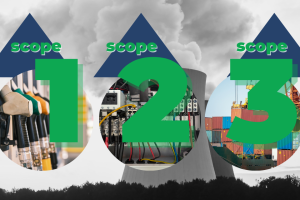
Scope 1: Direct emissions
These come from sources you own or control directly. Think: company vehicles, onsite fuel combustion (e.g. boilers, generators), or emissions from manufacturing processes.
Scope 2: Indirect emissions from purchased energy
These are emissions from the electricity, steam, or heating and cooling you purchase and use.
Scope 3: Value chain emissions (indirect)
This is the largest and most complex category. It includes emissions from:
- Your suppliers
- Business travel
- Product distribution
- Waste and disposal
- The use of products you sell
Scope 3 often makes up 70–90% of a company’s total emissions, and it’s increasingly under scrutiny from clients, regulators, and investors to report upon. A business has to know these emissions if they are to achieve net zero.
Why Act Now?
If your business is planning to set a net zero target by 2030, 2040 or 2050 — you need to establish your baseline now. Why?
- You’ll need at least 3 years of historical reporting to show credible progress.
- Many industry certifications and ESG frameworks require a baseline year as early as possible.
- Waiting means you’ll fall behind on regulatory and market expectations — and lose out on competitive opportunities.
- If you are already implementing sustainable practices, you want to be able to evidence the impact of this.
Getting Started Is Easier Than You Think
At Neutral Carbon Zone, we’ve designed tools and services that help organisations like yours get started, even if you’re new to carbon reporting.
🙋🏻♂️ We can help you set your baseline, help you understand it and help you action it within a carbon reduction plan, all included in our Gold Award.
Get in touch today and book in a call here:
https://zcal.co/t/csm/nczexploratory
Contact us: jacob@neutralcarbonzone.com