
Your Supply Chain is Talking. Are You Listening?
Halfway through the year, most organisations remain blind to their largest emissions driver. They understand their direct emissions well: energy consumption, transport, waste management. Yet they cannot see what happens beyond their gates, the carbon locked in raw materials, embedded in shipping routes, and woven through supplier decisions that shape their true environmental footprint. This invisible portion is Scope 3, and for most UK organisations, it represents the dominant force in their overall carbon story.
The challenge is that Scope 3 has always been easy to overlook. It does not show up on an invoice in tonnes of carbon. It sits in someone else’s factory, someone else’s lorry, someone else’s energy mix. But that comfortable distance is closing fast. Regulators now expect supply chain emissions to be measured and disclosed. Procurement teams are asking suppliers for hard data before contracts are signed. Investors want to know that a net zero pledge accounts for the whole value chain, not just the easy 15 per cent a business directly controls.
Here is the uncomfortable truth for many organisations. You can run the most efficient operation in your sector, with solar on the roof and electric vehicles on the road, and still be carrying a carbon footprint several times larger than your own walls suggest. Until you look at your supply chain, you simply do not know the size of the gap. And increasingly, the people who matter most, your clients, your partners, your regulators, are the ones asking you to find out.
The good news is that the businesses choosing to listen are discovering something valuable. Supply chain visibility is not just a compliance exercise. It reveals inefficiencies, strengthens supplier relationships, and uncovers savings that were hiding in plain sight. Your supply chain has been talking all along. The only question is whether you are ready to hear what it has to say.
From Hidden Emissions to Competitive Advantage: Why Understanding Scope 3 Pays Off
Understanding your Scope 3 emissions might sound like a technical exercise for sustainability specialists, but the businesses that take the time to map their supply chain tend to unlock advantages that reach well beyond their carbon reports. The most immediate is commercial. Procurement teams increasingly screen suppliers on carbon performance before a deal is signed, so being able to produce credible, evidenced data makes you the easy choice while competitors offering only good intentions get filtered out. The same scrutiny that reveals your emissions also reveals inefficiency, and lighter packaging, smarter logistics routing, and consolidated suppliers often cut cost and carbon in the same move.
The benefits compound over time. Understanding your suppliers deeply enough to measure their emissions means understanding their operations, their dependencies, and their risks, which builds a more resilient supply chain when disruption hits. It also shifts supplier relationships from transactional to collaborative, turning price negotiations into shared goals. Suppliers willing to invest in improvement tend to be the most reliable and innovative partners a business can have, and that partnership grows more valuable with every year.
Perhaps most importantly, understanding Scope 3 keeps you ahead of the curve rather than scrambling to catch up. Reporting requirements are tightening steadily, and organisations that act now will adapt smoothly as the rules evolve. Beyond compliance, the ability to demonstrate real, measured progress across your entire value chain earns a credibility that bold pledges cannot match. In a market crowded with sustainability claims, evidence is what sets you apart, and that is how a quiet liability becomes a lasting competitive edge.

At NCZ, we meet very few businesses that struggle to count what happens inside their own four walls. The difficulty almost always begins beyond them, in the purchased materials, the inbound freight, and the supplier operations that quietly drive the bulk of a company’s emissions. Knowing this layer exists is one thing; proving it to a regulator, a buyer, a customer or an investor is another entirely. That is the work we specialise in. We take companies through a disciplined accounting process and then certify what we find, so that a tangle of partial supplier figures becomes a single, verifiable account of the whole value chain. Instead of asking organisations to interpret complicated guidance on their own, we supply the method, do the heavy lifting on the calculations, and attach independent assurance to the outcome.
Choosing the right partner changes what that effort is worth. Mapping a value chain will always surface waste to trim and routes to tighten, but those wins only persuade anyone when an outside authority has checked the workings. Our certification is what lets a company clear a procurement gate, answer an investor’s questions about its net zero commitment, and tell a client that the progress on paper is genuine. When everyone in the market is making claims, a mark that has been earned through independent verification is the difference between being believed and being doubted. Work with us, and the figures a business reports stop being assertions and become credible evidence.
There is also a timing advantage we want clients to feel. Disclosure rules are not standing still, and the organisations that put certified accounting in place today will move with each new requirement instead of racing to satisfy it. The same depth of understanding that produces a credible carbon figure also reveals where a supply chain is fragile and where a supplier could become a long term ally rather than a line item. Our role is to turn what looks like an intimidating obligation into a route a company can follow again and again. With NCZ measuring and certifying alongside them, businesses can finally do something useful with everything their supply chain has been telling them, and convert a quiet exposure into a durable advantage.

From Scale to System: Kingdom Services Group’s Path to Platinum
Kingdom Services Group had been managing sustainability across its operations for years. As one of the UK’s most established facilities management groups operating across four distinct business entities, they had pieces of a sustainability story. The only thing missing was the evidence to back it up.
That is where NCZ came in. What started as a single conversation grew into something far more structured. Gathering the data from multiple systems, building internal understanding, and bringing colleagues along the journey across a largely dispersed workforce was not a light undertaking. But the groundwork paid off. Kingdom Services Group has since achieved NCZ Platinum Certification and is now working steadily towards meaningful carbon reduction.
What makes the Kingdom Services Group story worth reading is not just the certification. It is the honesty behind it. The challenges of collecting reliable data across four separate business entities. The anomalies that surfaced during the carbon footprint process and what they revealed. And the way sustainability has quietly shifted from an internal ambition into a competitive advantage that now features in every new business pitch the company puts forward.
Read the full story on our website and see what the journey from scale to system actually looks like in practice.


The Hidden Carbon in Your Value Chain
Did you know that 60-90% of most companies’ carbon footprints come from Scope 3 emissions.
The indirect emissions they don’t directly control? Unlike Scope 1 (fuel consumption and fugitive evacuation) and Scope 2 (purchased electricity, heat, and steam), Scope 3 encompasses the entire value chain. It includes purchased goods and services, business travel, employee commuting, waste disposal, use of sold products, and transportation and distribution both upstream and downstream. Despite making up the majority of corporate carbon footprints, these “invisible” emissions often go unmeasured and unmanaged.
Scope 3 emissions are particularly significant because they extend far beyond a company’s direct operations and facilities. They capture the real-world impact of every product journey, from supplier manufacturing through customer use and final disposal. For example, transportation and distribution represents a substantial portion of these emissions, affecting everything from raw material sourcing to last-mile delivery. By understanding and addressing these hidden emissions throughout the entire supply chain, companies can identify the most impactful reduction opportunities.
The challenge with Scope 3 emissions is that they require collaboration across entire supply chains and industries. Companies must work with suppliers, logistics partners, and customers to gather data and identify reduction opportunities. However, this complexity also presents a unique advantage: by focusing on Scope 3 reduction strategies, businesses can drive positive environmental change far beyond their own operations, influencing practices across their entire value chain and contributing meaningfully to global climate goals.
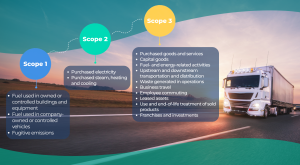

Most companies only see the tip of the iceberg when it comes to their carbon footprint. While everyone focuses on what happens inside their office doors, the real story and the real savings are hiding in plain sight across their supply chains. Scope 3 emissions represent the indirect greenhouse gases generated throughout your entire value chain, from the raw materials your suppliers source to how customers use and dispose of your products. For most organizations, these indirect emissions account for 60 to 90 percent of their total carbon footprint. Yet many companies overlook them entirely, focusing only on their direct operations. This oversight isn’t just an environmental miss; it’s a business blind spot. High-emission activities often correlate with high-cost activities such as energy-intensive logistics, wasteful procurement, and inefficient material use. Understanding Scope 3 emissions is where businesses discover millions in cost reductions and competitive advantages they didn’t know existed.
When companies approach Scope 3 systematically and strategically, they don’t just meet their climate commitments. They grow their market share, strengthen their brand image with consumers and investors, and build trust with vendors and stakeholders. As regulations tighten and investors increasingly scrutinize carbon performance, understanding your Scope 3 emissions is no longer optional. It’s a business imperative.
Key General Advantages for All Companies (Small & Large):
For most businesses, the majority of their GHG emissions and cost reduction opportunities are outside their own operations, making Scope 3 understanding essential regardless of company size.
1. Discovering Significant Cost Reduction Opportunities
High-emission activities often correlate with high-cost activities such as energy-intensive logistics, wasteful procurement, and inefficient material use. Scope 3 data frequently surfaces savings opportunities that would otherwise stay hidden.
- Building Trust & Credibility with Stakeholders
Companies that invest in sustainability, including measurement and reduction of scope 3 emissions, can improve their brand image among consumers, vendors they sell to, and other stakeholders. Procurement teams increasingly request scope 3 data from suppliers, and investors and lenders use it to assess transition risk. Credible numbers are a competitive differentiator, not just a reporting exercise. - Gaining Early-Mover Competitive Advantage
Enterprises that track their Scope 3 emissions will move ahead of the curve and gain an early mover advantage when businesses inevitably pivot to a low-carbon economy. - Better Supply Chain Visibility & Risk Management
Understanding where your emissions concentrate reveals where you may be exposed to carbon pricing, resource scarcity, and supplier disruption, before these risks hit your cost base. - Meeting Future Regulatory Requirements
Many countries have set limits and targets for greenhouse gas emissions, including Scope 3 emissions. Companies can avoid penalties or fines by measuring their emissions.

The Unexpected Leaders in Climate Action
Most conversations about sustainability and climate action focus on massive corporations and mega-corporations. But what if some of the most meaningful change is happening at community level in places like a non-league football club in the English Midlands?
In this episode of Emission Possible, Alan sits down with David Faulkner, Chairman and CEO of Redditch United Football Club, to explore how leadership, identity, and environmental responsibility come together in unexpected places. Founded in 1891, Redditch United is proving that a 130-year-old community institution can be just as committed to carbon neutrality as any tech startup or multinational corporation.
David shares the journey of how he guided the club through measuring its carbon footprint, implementing a reduction plan, and achieving carbon neutral certification. But beyond the sustainability metrics, this conversation reveals something deeper. How a football club can become the beating heart of its town, tackling not just environmental challenges but social ones too. David talks candidly about rebuilding community identity, bringing global partners to a small Midlands town, and reimagining what a football club can stand for in 2026. He’s refreshingly honest, wildly entertaining, and operating at a completely different level than your typical boardroom suit.
Whether you work in sustainability, community development, or just believe that business has a responsibility to its people, this episode will challenge how you think about impact and leadership. David’s story proves that you don’t need a global megaphone to create real change. Sometimes all you need is a club, a community, and the courage to do things differently.
Listen to the full episode HERE.

Mapping your supply chain is not about making headlines. It is about building the foundation for decisions that matter in the long term.
If you are ready to turn supply chain complexity into competitive advantage, we are here to guide you.
Real change does not arrive overnight. It emerges through thoughtful, data-driven choices made consistently across your value chain. When you have clarity on where your emissions truly live, sustainability stops feeling abstract and starts becoming actionable.