
Purpose
A clear, pragmatic guide to creating a robust Carbon Reduction Plan that meets public-procurement expectations, aligns with global accounting standards, and positions organisations for credible, measurable decarbonisation.
Audience
Procurement, sustainability, finance and commercial teams preparing bids, contract compliance, or strategic decarbonisation roadmaps.
Executive summary
A Carbon Reduction Plan should not be treated as a template exercise. A compliant CRP may help an organisation pass a procurement requirement, but a credible CRP should also provide a practical route to reducing emissions, improving supplier engagement and strengthening commercial resilience.
A CRP is a public statement of intent and a documented roadmap describing how an organisation will reduce greenhouse gas emissions across its operations and value chain. In the UK public procurement context, suppliers bidding for major central government contracts are expected to publish a CRP aligned with the relevant Procurement Policy Note.
Complying with requirements is now a baseline expectation. Increasingly, organisations are being evaluated on the quality, transparency and credibility of their plans, not just their presence.
Why a CRP matters (commercially and legally)
- Procurement compliance & contract eligibility. PPN 006 replaced the previous PPN 06/21 terminology and sets out how Carbon Reduction Plans are considered in the procurement of major government contracts. Contracts above defined thresholds reference these requirements and expect publicly accessible CRPs. Failing to provide a compliant CRP can materially damage bid competitiveness.
- Investor, customer and insurer expectations. Investors, corporate buyers and financial institutions increasingly expect quantifiable climate commitments; a robust CRP signals governance and risk management. (See SBTi and other target frameworks below.)
- Operational risk & cost control. CRPs drive energy efficiency, logistics optimisation, and supplier engagement, actions that typically reduce cost and supply-chain risk over time.
(These three claims are core to decision making about CRPs and are supported by the UK government procurement guidance and recognised target-setting frameworks.)

Core components of a credible CRP
A high-quality CRP is concise, transparent and auditable. The following sections describe the minimum components that buyers (and many public-sector evaluators) will expect.
1. Organisational profile & declaration
- Legal name, trading names, and contact for the CRP.
- Declaration of alignment with public procurement requirements (e.g., PPN 006) where applicable.
- Senior sign-off / executive endorsement (board-level signatory).
2. Baseline emissions & methodology
- Clear reporting period and baseline year (e.g., FY 2023).
- Reported Scope 1 and Scope 2 emissions; Scope 3 categories relevant to your organisation (use GHG Protocol categories). The GHG Protocol and its Scope 3 Calculation Guidance provide the internationally accepted methodology for value-chain accounting and are the recommended baseline for consistent, comparable reporting.
3. Targets & timelines
- Short-term (5–10 year) emission reduction targets and long-term net-zero ambition (e.g., net zero by 2050 or earlier). Where possible, align targets to science-based criteria (SBTi) and state whether targets are validated or in development. The SBTi provides guidance on near-term and net-zero targets and is widely recognised for scientific rigour.
4. Reduction measures & action plan
- Specific interventions, assigned owners, timelines, and estimated emissions impact. Actions should cover operational energy, procurement choices (low-carbon materials, supplier engagement), logistics, product design and demand-side measures. Prioritise high-impact Scope 3 categories if they drive most of your footprint.
5. Data quality, verification & tools
- Explain data sources, assumptions, emissions factors, and any third-party verification. Reference the emissions factors used (e.g., national conversion factors) and the accounting standard applied (GHG Protocol / ISO 14064). Describe plans for improving data quality over time.
6. Governance, resources & stakeholder engagement
- Governance structure (board oversight, sustainability sponsor), internal resources and supplier engagement approach. For complex supply chains, show how suppliers will be supported (phased reporting, templates, training). The Crown Commercial Service (CCS) guidance recommends practical, supplier-friendly CRP approaches.
7. Residual emissions & carbon removal
- Clearly set out your position on residual emissions, offsets and carbon removals. A credible CRP should demonstrate that emissions reduction comes first, with offsets or removals considered only for unavoidable residual emissions.
8. Monitoring, reporting & continuous improvement
- Monitoring, reporting and continuous improvement are essential to maintaining a credible Carbon Reduction Plan. Organisations should commit to at least an annual review cycle, supported by clear KPIs and defined reporting mechanisms, ensuring progress is measurable and transparent. The CRP should also remain publicly accessible, with regular updates to demonstrate accountability and ongoing progress.
A CRP becomes valuable when it translates emissions data into targeted, practical action.
For example, if purchased goods and services represent the largest share of an organisation’s emissions, focusing only on office energy or vehicle use will have limited impact. Instead, the plan should include a structured supplier engagement approach, improved procurement data collection, clear supplier reporting expectations and a phased approach to improving Scope 3 accuracy. This ensures effort is focused where it will deliver the greatest reduction.

Practical steps to prepare a CRP (accelerated checklist)
- Assemble a cross-functional team. Include procurement, finance, operations, sustainability and legal. Assign an executive sponsor.
- Select baseline year & gather data. Use energy bills, fuel use, company vehicles, business travel and a prioritized list of Scope 3 categories. Where supplier data is missing, use spend-based methods as an interim approach (then improve over time).
- Choose standards & conversion factors. Use GHG Protocol (and GHG Scope 3 guidance) for methodology and national conversion factors for consistency.
- Set targets aligned to business realities. Decide near-term reductions and a net-zero ambition; consider SBTi alignment for credibility.
- Draft action plan & resource allocation. Identify low-hanging wins (energy efficiency, LED lighting, fleet electrification), procurement levers (supplier KPIs, product redesign), and higher-investment projects (renewable PPAs, circular design).
- Publish & update publicly. Host the CRP where it is easily found (company site, tender portal) and commit to annual reporting. Government procurement expects public accessibility.
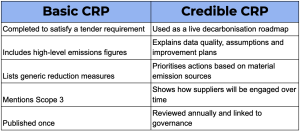
Compliant vs credible CRP
A useful way to assess the strength of a CRP is to distinguish between what is compliant and what is credible.
Common pitfalls and how to avoid them
- Over-ambition with no pathway. Setting net-zero dates without an evidence-based roadmap undermines credibility. Avoid by pairing ambition with short-term, measurable milestones.
- Ignoring Scope 3. For most organisations, Scope 3 dominates impacts; treating it as optional creates strategic blind spots. Use spend-based or activity-based approaches as pragmatic first steps and improve granularity over time.
- Poor data governance. Incomplete data or unclear assumptions create audit risk. Document assumptions, use established emission factors, and plan to improve data quality incrementally.
- Relying on low-quality offsets. A credible CRP should prioritise direct emissions reductions first. Offsets or removals should only be considered for unavoidable residual emissions, not as a substitute for action. Where used, organisations should always disclose the standard, registry, project type and evidence of retirement, and clearly distinguish carbon neutrality claims from net zero commitments.
Where NCZ can help (practical support)
NCZ helps clients turn CRP requirements into practical action: rapid baseline calculation, supplier engagement programme, CRP drafting aligned to procurement rules (including PPN 006 guidance), and roadmap development that links targets to procurement levers. We also advise on credibility pathways (SBTi alignment, ISO 14064 implementation) and assist with measurable supplier programmes that scale data quality across complex supply chains.
Key references & further reading
- UK Government: Carbon reduction plan, official template and guidance. (GOV.UK)
- Procurement Policy Note (PPN 006) Taking account of Carbon Reduction Plans in procurement of major government contracts (Feb 2025). (GOV.UK)
- Crown Commercial Service: How to create a Carbon Reduction Plan (CRP), practical guidance for suppliers. (crowncommercial.gov.uk)
- GHG Protocol: Scope 3 Calculation Guidance and Corporate Value Chain (Scope 3) Standard, the global accounting standards for value chain emissions. (GHG Protocol)
- Science Based Targets initiative (SBTi): Guidance on near-term and net-zero targets. (Science Based Targets Initiative)
- ISO 14064: International standards for GHG quantification and reporting. (ISO)